
How to Measure Bra Size in India? Your Complete Guide to Finding the Perfect Fit


Let's be honest, most of us have no idea what our actual bra size is. We guess, we grab what looks about right, or we keep buying the same size we wore five years ago, even though our body has changed.
Here's a fact that might surprise you: studies show that up to 80% of women wear the wrong bra size. That's not because we're doing it wrong on purpose—it's because nobody ever taught us how to measure properly.
If you've been dealing with straps that dig in, bands that ride up, or cups that gap or overflow, your bra size is probably off. The good news? Measuring yourself takes about 5 minutes, costs nothing, and can completely change how comfortable you feel every day.
Let's walk through exactly how to measure your bra size in India, understand what those measurements mean, and figure out your actual cup size, whether you're an A, B, C, D, or beyond.
Why Measuring Your Bra Size Actually Matters?
Before we get into the how-to, let's talk about why this matters.
Your bra does 80% of the support work through the band, not the straps.
If your band size is wrong, nothing else will fit right. Too loose, and you get no support. Too tight, and you can't breathe properly.
Your cup size determines whether your breast tissue fits comfortably in the bra. Too small, and you get spillage (quad-boob). Too large, and you get gapping and wrinkles.
Neither looks good under clothes, and both feel uncomfortable.
When your bra fits properly, you barely notice you're wearing it. When it doesn't fit, you spend all day adjusting, pulling, and being uncomfortable.
That's the difference proper measurements make.
What You Need to Measure Bra Size in India?
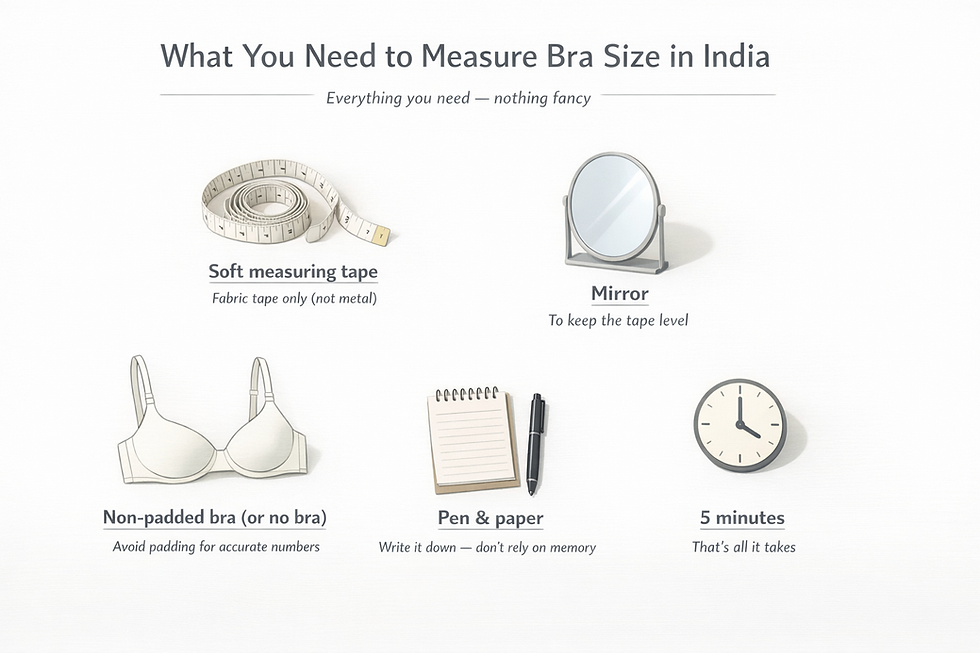
You don't need fancy equipment or a professional fitter (though if you can get professionally fitted, that's great). Here's what you need:
A soft measuring tape - The fabric kind used for sewing, not the hard metal kind used for construction. You can get one from any tailoring shop or online for under ₹50.
A mirror - Full-length is best, but any mirror that lets you see your torso works. You need to check that the measuring tape is level all the way around.
A non-padded bra or no bra - Padded bras add volume that isn't yours, which throws off measurements. Wear an unlined bra or sports bra, or go braless for the most accurate measurements.
A pen and paper - Write down your measurements. Don't try to remember them you'll forget.
5 minutes of time - That's it. This doesn't take long.
How to Measure Your Band Size?

Your band size is the foundation of your bra fit. Get this wrong, and nothing else matters.
Step 1: Measure your underbust
Stand up straight in front of your mirror. Wrap the measuring tape around your ribcage, directly under your bust. The tape should be snug but not tight, you should be able to breathe normally. Make sure the tape is level all the way around your body (not riding up in the back or sagging in the front).
Take this measurement in inches. Write it down.
Step 2: Round to the nearest even number
Bra sizes go in even numbers: 28, 30, 32, 34, 36, 38, 40, and so on. If your measurement is already an even number (like 32 inches), that's probably your band size. If it's an odd number (like 33 inches), round to the nearest even number.
Here's how to round:
If you measure 31 inches → Try 32 band
If you measure 33 inches → Try 32 or 34 band (try both to see which feels better)
If you measure 35 inches → Try 36 band
Some women prefer to add 4-5 inches to their underbust measurement using old sizing methods, but this usually gives you a band that's too loose.
Modern bra fitting uses your actual underbust measurement for the band size, which provides better support.
How to Measure Your Cup Size?

Your cup size is the difference between your underbust and your full bust. This is where a lot of confusion happens, but it's actually simple math.
Step 1: Measure your full bust
Wear a non-padded bra or no bra. Stand up straight and wrap the measuring tape around the fullest part of your bust. This is usually at nipple level, but it varies depending on your breast shape.
Make sure the tape is level all the way around—not drooping in the front or riding up in the back. The tape should be snug but not tight. Take this measurement in inches and write it down.
Step 2: Calculate the difference
Subtract your underbust measurement from your full bust measurement. The difference tells you your cup size.
Here's the cup size chart:
1 inch difference = A cup
2 inches difference = B cup
3 inches difference = C cup
4 inches difference = D cup
5 inches difference = DD/E cup
6 inches difference = DDD/F cup
And it continues from there. Cup sizes don't stop at D or DD, they go much higher.
Example calculation:
Underbust: 32 inches
Full bust: 35 inches
Difference: 35 - 32 = 3 inches = C cup
Your size: 32C
Understanding A Cup Bra Measurement
An A cup means there's a 1-inch difference between your underbust and full bust measurements.
A cup example:
30 inches underbust + 31 inches bust = 30A
32 inches underbust + 33 inches bust = 32A
34 inches underbust + 35 inches bust = 34A
36 inches underbust + 37 inches bust = 36A
Notice that all these are A cups, but they're not the same size.
A 36A holds more volume than a 30A because the band is bigger. This is why you can't just say "I'm an A cup" without mentioning the band size.
A cup is often considered the smallest standard cup size (though AA exists), but "small" doesn't mean anything negative. An A cup is just a measurement.
If you measure as an A cup, that's your size. There's nothing wrong with it, and properly fitted A cup bras look great and feel comfortable.
For more details about A cups and finding the right bras, read more about what does A cup means.
Understanding B Cup Bra Measurement
A B cup means there's a 2-inch difference between your underbust and full bust measurements.
B cup examples:
30 inches underbust + 32 inches bust = 30B
32 inches underbust + 34 inches bust = 32B
34 inches underbust + 36 inches bust = 34B
36 inches underbust + 38 inches bust = 36B
B cup is one of the most common cup sizes, which means most bras are designed with B cups in mind. You'll have lots of style options, t-shirt bras, bralettes, balconettes, wireless bras, pretty much everything works for B cups.
The nice thing about B cups is that you don't need heavy-duty support features that larger cups require, but you have enough volume that bras designed for smaller cups work well too. It's a versatile size.
Want to know more about B cup sizing and the best bras for this size? Check out what does B cup means.
Understanding C Cup Bra Measurement
A C cup means there's a 3-inch difference between your underbust and full bust measurements.
C cup examples:
30 inches underbust + 33 inches bust = 30C
32 inches underbust + 35 inches bust = 32C
34 inches underbust + 37 inches bust = 34C
36 inches underbust + 39 inches bust = 36C
C cup is where you start needing more structured support. Wireless bras can still work, but you'll probably want underwire for everyday wear.
Full coverage becomes more important to prevent spillage, and strap width matters more for comfort.
C cups are common and widely available in India, so you'll have plenty of options when shopping.
Just make sure you're getting bras with proper support, check for wide straps, multiple hook rows, and quality construction.
Understanding D Cup Bra Measurement
A D cup means there's a 4-inch difference between your underbust and full bust measurements.
D cup examples:
30 inches underbust + 34 inches bust = 30D
32 inches underbust + 36 inches bust = 32D
34 inches underbust + 38 inches bust = 34D
36 inches underbust + 40 inches bust = 36D
D cups need good support—this is non-negotiable. Look for bras with underwire, wide straps, multiple hook rows (at least 3), and full coverage.
Sports bras should be high-impact with proper encapsulation.
Many women who think they're B or C cups are actually D cups or larger. If you're constantly dealing with spillage or your bras feel too small, measure yourself—you might be a D cup.
For complete information about D cup sizing and finding supportive bras, learn more about what does D cup means.
Common Bra Measuring Mistakes to Avoid
Mistake 1: Measuring over a padded bra Padded bras add volume that isn't yours. This makes your bust measurement larger than it actually is, which means you'll calculate the wrong cup size. Always measure in a non-padded bra or braless.
Mistake 2: Measuring tape not level If your tape is angled (higher in front, lower in back, or vice versa), your measurements will be off. Check in a mirror to make sure the tape is parallel to the floor all the way around.
Mistake 3: Pulling the tape too tight or too loose Too tight, and your measurements are smaller than reality. Too loose, and they're larger. The tape should be snug but comfortable—you should be able to breathe normally.
Mistake 4: Not remeasuring when your body changes Weight gain or loss, hormonal changes, pregnancy, age—all these affect breast size. If your bras don't fit the same way they used to, remeasure. Your size can change, and that's completely normal.
Mistake 5: Adding inches to your underbust Old sizing methods told women to add 4-5 inches to their underbust measurement. This gives you a band that's way too loose. Use your actual underbust measurement for modern bra sizing.
Mistake 6: Giving up after one measurement Bodies aren't perfectly symmetrical, and measurements can vary slightly depending on time of day, where you are in your cycle, and how you're standing. If something seems off, measure again.
How to Check If Your Measured Bra Size Is Correct?
Measurements give you a starting point, but the real test is how the bra actually fits. Here's how to check:
The band test: Put the bra on using the loosest set of hooks. The band should feel snug but not painful. You should be able to fit two fingers under the band, but not your whole hand. The band should stay level all the way around your body if it rides up in the back, the band is too loose.
The cup test: Your breast tissue should fill the cup without spillage or gapping. No "quad boob" (tissue spilling over the top), no wrinkles or air pockets in the cup. The underwire should sit on your ribcage, not on any breast tissue.
The center gore test: That piece of fabric between the cups should lay completely flat against your sternum. If it's floating away from your body, the cups are too small. If it's digging in painfully, something's wrong with the fit.
The strap test: Straps should stay on your shoulders without slipping, and they shouldn't dig painful grooves. If straps are constantly slipping or you're constantly adjusting them, your band is probably too loose.
The comfort test: You should be able to wear this bra for 8+ hours without wanting to rip it off. If it hurts in the fitting room, it'll hurt worse after a full day.
If your measured size fails any of these tests, try your sister sizes. Sister sizes have the same cup volume but different band sizes.
For example, if you measured as a 34B but the band feels too loose, try 32C (tighter band, same cup volume).
Sister Sizing: When Your Measurements Are Between Sizes
Sister sizes are different bra sizes that hold the same cup volume. This is useful when you're between band sizes or when a brand runs large or small.
How sister sizing works: When you go down one band size, go up one cup size to maintain the same volume. When you go up one band size, go down one cup size.
Examples:
32A = 30B = 34AA (same cup volume, different bands)
32B = 30C = 34A (same cup volume, different bands)
32C = 30D = 34B (same cup volume, different bands)
32D = 30DD = 34C (same cup volume, different bands)
When to use sister sizing:
Your underbust measures 33 inches (between 32 and 34 bands)
Your regular size's band feels slightly loose or tight
A brand you like runs large or small
You've gained or lost a little weight but not enough to change sizes completely
Try your regular size and both sister sizes to see which feels best. The "correct" size is whichever fits best, not whichever matches your measurements exactly.
Find Perfect Sister Size for your bra: Sister Size Finder
What to Do If Your Measurements Don't Match Standard Sizes?
Sometimes your measurements fall outside standard sizing. Maybe your underbust is 27 inches (smaller than most 28 bands), or your cup size difference is 7+ inches (beyond standard DD/DDD sizing).
This doesn't mean you can't find bras that fit—it just means you need to look beyond mainstream brands.
If you measure smaller than standard sizes (under 28 band): Look for brands that specialize in smaller bands. Some international brands go down to 26 or even 24 bands. In India, you might need to look at specialized retailers or order online from brands that carry extended sizing.
If you measure larger cup sizes (beyond D/DD): Cup sizes go beyond D, there's DD/E, DDD/F, G, H, and so on. Many Indian brands don't carry these sizes in stores, but they exist. Look for brands that specialize in fuller bust sizing or shop online from retailers that carry extended cup sizes.
If your measurements are between sizes: Try both sizes and use sister sizing. If you measure 33 inches underbust with a 36-inch bust (3-inch difference = C cup), try both 32C and 34C to see which fits better. There's no single "right" answer—it's whichever fits your body best.
How Often Should You Remeasure Your Bra Size?
Your bra size isn't fixed forever. Bodies change, and your bra size should change with it.
Remeasure yourself when:
You gain or lose 10+ pounds (even 5-10 pounds can change your size)
You're pregnant or breastfeeding (your body changes a lot)
You notice your bras don't fit the same way they used to
Your weight has stayed the same, but you look different (body composition can change without weight changing)
It's been more than a year since you last measured
You're starting or stopping hormonal birth control (hormones affect breast size)
You're going through puberty or menopause (major hormonal changes)
A good rule of thumb: measure yourself once a year, even if you think nothing has changed. Bodies shift over time, and you might be surprised.
Shopping for Bras After Measuring
Now that you know your measurements, here's how to shop:
Try before you buy when possible. Measurements are a starting point, but brands fit differently. What works in one brand might not work in another, even in the same size.
Order multiple sizes online if you can't try in person. Get your measured size and both sister sizes. Most online retailers have good return policies, use them.
Start with neutral colors in your new size. Get nude (matching your skin tone), black, and white. These work on 90% of your clothes. Save the fun colors and patterns until you're sure about your size.
Check the return policy before buying. You might need to exchange for a different size or style, especially when you're first figuring out your correct size.
Don't just grab one bra and leave. Bodies are asymmetrical, brands fit differently, and you might need different sizes in different styles from the same brand. If something doesn't fit right, try another size or style.
Finding the Right Bras for Your Size at Unhooked India
Measuring yourself is the first step to finding bras that actually fit. But measurements are just numbers; the real goal is comfort, support, and feeling good in what you're wearing.
Unhooked India offers a range of sizes designed for Indian women's bodies, with proper support and quality construction.
Whether you're an A, B, C, D cup or beyond, you'll find options that fit your measurements and your lifestyle.
Remember: your bra size is just a measurement, not a judgment on your body. There's no "good" or "bad" size, there's only the size that fits you.
Measure accurately, try things on, and don't be afraid to go up or down a size if that's what fits better.
Your perfect-fitting bra is out there. Now you know how to find it.


The best thing about Scrandle is that every comparison gives you something to think about. A dish that looks better is not always the one with the stronger crowd rating.
Ik waardeer de objectieve toon van dit artikel. De groei van interactieve digitale diensten laat zien hoe gebruikerservaringen blijven evolueren. Aanvullende achtergrondinformatie over dit onderwerp is te vinden op de website. Deze inzichten helpen om digitale trends beter te begrijpen.